
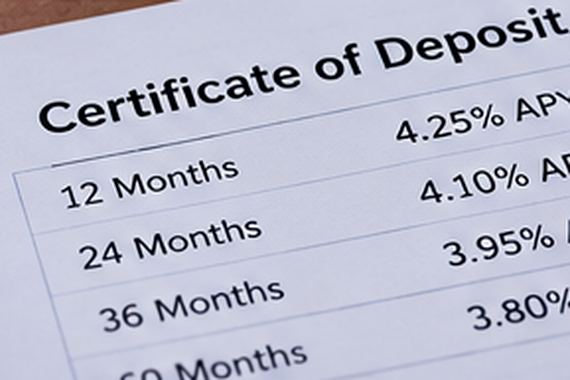
Certificates of deposit, commonly known as CDs, are one of the oldest savings products offered by U.S. banks and credit unions.
A CD is designed for money that a saver does not expect to need immediately.
Instead of keeping the funds fully liquid, the customer agrees to leave the money deposited for a specific term. In exchange, the institution provides a stated interest rate or APY.
The Consumer Financial Protection Bureau explains that withdrawing money before the CD reaches maturity will generally result in an early-withdrawal penalty.
Official reference: CFPB Certificate of Deposit Guide
How CDs Work
Suppose a consumer has $10,000 that will not be needed for one year.
They could place the money into a 12-month CD.
The rate is typically established when the CD is opened. At maturity, the consumer receives the original deposit plus accumulated interest, assuming the terms are satisfied.
CD terms can range from a few months to several years.
Longer terms do not automatically provide better value. The relationship between short- and long-term interest rates changes over time.
Consumers should therefore compare current offers rather than assuming a five-year CD always pays more than a one-year CD.
The Importance of Early-Withdrawal Penalties
Liquidity is the main tradeoff.
If a consumer unexpectedly needs the money before maturity, the bank may charge a penalty.
Depending on the institution and CD term, that penalty may represent several months of interest or another amount defined in the account agreement.
This is why CDs are generally not ideal for money that represents someone’s entire emergency fund.
The CFPB advises consumers to compare the term, interest rate and early-withdrawal penalty before opening a CD.
Are CDs FDIC-Insured?
CDs issued by FDIC-insured banks are deposit products eligible for FDIC protection within applicable limits.
The standard insurance amount is $250,000 per depositor, per insured bank, for each ownership category.
Official reference: FDIC Deposit Insurance
Credit-union CDs, often called share certificates, may instead be covered by National Credit Union Administration insurance when issued by a federally insured credit union.
Consumers should always verify the institution and understand how total deposits at that institution interact with insurance limits.
CD vs. High-Yield Savings Account
A high-yield savings account generally provides greater access to cash.
The tradeoff is that savings-account rates are variable. A bank can raise or lower the APY as market conditions change.
A traditional fixed-rate CD allows the customer to lock in a rate for a defined period.
That can be beneficial when interest rates subsequently fall.
It can be less attractive when rates rise significantly after the CD is opened because the depositor remains locked into the earlier rate unless they accept the cost of an early withdrawal.
CD vs. Treasury Bills
CDs and Treasury bills are both commonly used for short-term savings, but there are important differences.
A bank CD is a deposit product and may be FDIC-insured.
A Treasury bill is a U.S. government security and is not covered by FDIC deposit insurance.
Treasury interest is generally exempt from state and local income taxes, which may give T-bills an advantage for taxpayers in states with state income taxes.
The better choice can depend on current yields, tax circumstances and liquidity needs.
CD Ladder Strategy
A CD ladder can help reduce the liquidity problem.
Instead of placing $20,000 into one four-year CD, a saver could divide the money into several CDs with different maturity dates.
For example, $5,000 could mature each year for four years.
When the first CD matures, the customer can either use the money or reinvest it into a longer-term CD.
Eventually, the saver can maintain longer-term rates while having part of the portfolio mature regularly.
The same general concept can also be used with Treasury securities.
Watch for Automatic Renewal
Many CDs automatically renew at maturity unless the customer takes action during a grace period.
The new CD may have a different interest rate.
Consumers should therefore set reminders before maturity rather than assuming the money will automatically roll into the best available product.
This is a good time to compare competing banks, Treasury bills and high-yield savings accounts.
When a CD Makes Sense
CDs may work well for predictable future expenses.
Examples include money for a wedding next year, part of a home down payment, tuition due in a future semester or cash that a retiree expects to use at a known date.
The product becomes less appropriate when the timing of the expense is uncertain.
Final Thoughts
Certificates of deposit can be useful for savers who want predictable interest and do not need immediate access to their money.
The most important factors are APY, maturity, early-withdrawal penalties and deposit-insurance coverage.
Consumers should compare a CD not only with other CDs but also with high-yield savings accounts and Treasury bills.
The best product is the one that matches the date when the money will actually be needed.